



Function
Boston Rivet Suede Leather Stone Blue Walk Edit: First-Week Break-In, Strap Fit, and Hard-Floor Walking | BIRKENSTOCK Everyday Walk
Why the First Week Matters with the Boston Rivet Suede Leather
The BIRKENSTOCK Boston Rivet Suede Leather is a clog that asks for a little patience before it gives you everything. That first week is not about suffering through a stiff shoe; it is about letting the cork footbed read your foot and letting the suede upper relax where it needs to. The Stone Blue colorway in this Walk Edit is a muted, denim-like tone that hides scuffs well, which matters when you are wearing the same pair from the kitchen to the curb to the coffee shop. The Rivet detailing along the strap adds a bit of structure without turning the clog into something fussy. If you have worn BIRKENSTOCK before, you know the cork footbed has a break-in curve. If this is your first pair, the Boston is actually a gentle place to start because the open back means less pressure across the instep while the footbed does its work. Over the next seven days, you will notice three things changing: the footbed softening under your arches, the strap settling across the top of your foot, and your walking pattern adapting to a firmer surface underfoot. That is the whole game. Everything else—how you style it, where you wear it—follows from those three adjustments.
Day 1 to Day 3: Cork Footbed Break-In Basics
The cork footbed in the Boston Rivet is the same contoured design BIRKENSTOCK has used for decades, but the Rivet Suede Leather version starts a touch firm. On day one, wear them around the house for 20 to 30 minutes. Not a full day. The cork needs warmth and pressure to begin molding, and short sessions give it that without irritating your arches. By day two, you can add a short walk to the mailbox or around the block. The footbed will feel hard at first, especially in the heel cup and under the metatarsal arch. That is normal. The cork is not broken in yet. By day three, most people notice the heel cup starting to feel less like a ledge and more like a cradle. The suede leather upper also begins to soften across the top of the foot. Stone Blue suede shows a little nap variation as it creases, which is part of the look. Do not rush this phase with thick socks or by wearing them for hours on end. The cork footbed adapts to your foot, not the other way around. If you feel pressure points on the top of your foot, loosen the strap one notch. If your heel lifts too much, tighten it one notch. The rivet-adjusted strap is there to dial in that fit, not to clamp down. By the end of day three, the Boston should feel noticeably different from day one—still structured, but no longer foreign.
Day 4 to Day 7: Strap Fit and Walking on Hard Floors
Days four through seven are when the Boston Rivet Suede Leather starts to feel like your shoe. The cork footbed has taken an impression of your heel and the ball of your foot. The suede leather has stretched just enough to stop pressing on the top of your foot. Now you can start wearing them on hard floors—tile, concrete, hardwood—for longer stretches. Hard floors are actually where the Boston shines because the cork footbed provides a buffer that soft-soled slippers do not. But the first few hard-floor walks may still feel firm. That is the cork doing its job. On day four, try a 30-minute errand on tile or pavement. On day five, wear them for a couple of hours at home while cooking or working at a standing desk. By day six, you should be able to walk a few blocks without thinking about your feet. By day seven, the footbed will have softened enough that you notice the arch support rather than the stiffness. The strap should sit flat across the instep without digging in. If you have a high instep, you may need to keep the strap on the loosest setting for the first week. If you have a narrow foot, the Boston may feel roomy—that is intentional. The clog is designed to let your foot move naturally, and the suede leather will conform over time. Stone Blue is a color that works with denim, grey wool, and even black trousers, so you can keep wearing them as they break in without looking like you are in recovery mode.
Width, Sizing, and the Suede Leather Factor
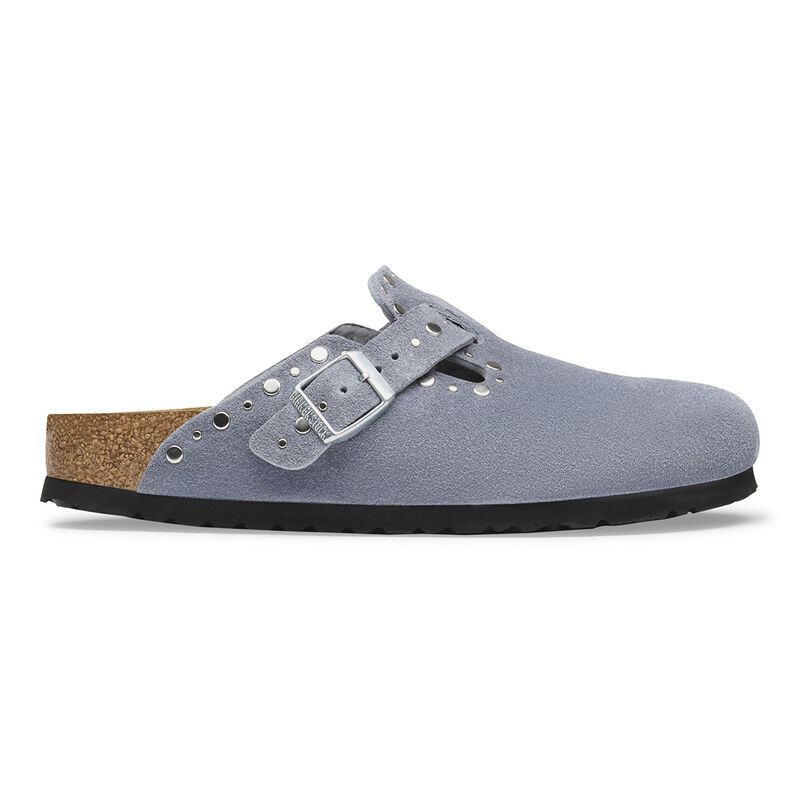
BIRKENSTOCK offers the Boston in narrow and regular widths. The Rivet Suede Leather follows that same fit. If you have never worn BIRKENSTOCK before, stand on a piece of paper and measure your foot from heel to toe, then compare to the brand's size chart. The Boston should have about a quarter-inch of space behind your heel and in front of your toes. Your toes should not touch the front edge. The suede leather upper is more forgiving than smooth leather or Birko-Flor because it stretches slightly with wear. That means if you are between sizes, you can often go with the smaller size and let the suede relax. But do not size down more than one. The cork footbed does not stretch lengthwise. The strap across the instep is adjustable via the rivet, and it should be snug enough to keep the clog on your foot without leaving marks. During the first week, check the strap tension every day. Suede leather can loosen a bit as it warms up, so you may need to tighten it once or twice. The Stone Blue color is a suede, so it will show water spots if you get caught in the rain. A suede brush and a protective spray will help, but for the first week, keep them out of puddles. The other colors in this Walk Edit—Black, Taupe, Zinfandel, Charcoal Tonal, Carafe Tonal, and Pepper—all share the same suede leather construction and rivet detail. Black and Charcoal Tonal hide scuffs best; Taupe and Carafe Tonal show a little more character; Zinfandel and Pepper are for when you want the clog to be the loudest thing in your outfit. Stone Blue sits in the middle: noticeable but not flashy.
Hard Floors, Long Walks, and the Boston Rivet Suede Leather
Walking on hard floors in a BIRKENSTOCK Boston is different from walking in a sneaker. The cork footbed is rigid under the arch and heel, which gives you a stable platform, but it does not have a foam midsole to bounce you forward. That is why the first week matters. Your feet and calves adjust to a more grounded stride. On day one, hard floors might feel jarring. By day seven, the same floor feels supportive. The Rivet Suede Leather outsole is a flexible EVA sole that grips tile and pavement without squeaking. It is not a deep-lug hiking sole, so for weekend travel, stick to city streets and light trails. The Boston is a clog, not a boot. But for airports, train stations, museums, and farmer's markets, it is hard to beat. The open back means your feet do not overheat, and the suede leather breathes better than synthetic materials. If you are standing all day—say, at a trade show or in a kitchen—the cork footbed will compress slightly and return, giving you a little energy return that a flat shoe lacks. Just remember to alternate with another pair if you are logging serious miles. No shoe should be worn every single day if you want it to last. The Boston Rivet Suede Leather in Stone Blue is a good candidate for a two- or three-day-per-week rotation. That gives the cork time to dry out and the suede time to recover its shape.
Color Notes for the Boston Rivet Suede Leather Walk Edit
Stone Blue is the focus of this Walk Edit, but the same model comes in six other colors. Black is the most stealthy and the easiest to wipe clean. Taupe is a warm neutral that pairs with almost anything. Zinfandel is a deep reddish-brown that reads as a statement without being bright. Charcoal Tonal keeps the rivet hardware subtle and works with dark denim. Carafe Tonal is a rich brown that looks especially good with wool socks in cooler months. Pepper is a dark, almost-black shade with a bit of texture. All of them use suede leather, so they will all break in the same way: slowly, then all at once. The Stone Blue version might show creasing a little more than Black or Charcoal Tonal, but that is part of the suede character. If you want a pair that looks better with wear, Stone Blue is a good choice. If you want a pair that looks the same on day one and day one hundred, go with Black. Either way, the first-week break-in is the same. Give the cork footbed time. Adjust the strap as needed. Walk on hard floors in short bursts. By the end of the week, the Boston Rivet Suede Leather will feel less like a shoe you are breaking in and more like a shoe that has been waiting for you.
Making the First Week Work for You
The biggest mistake people make with a new BIRKENSTOCK is wearing it for a full day right out of the box. The Boston Rivet Suede Leather is not a running shoe. It is a cork-footbed clog that rewards a gradual approach. Wear them for an hour on day one, two hours on day two, and so on. Use the strap to control the fit. If your foot slides forward, tighten the strap. If the top of your foot feels pinched, loosen it. Walk on hard floors when you can, because that is where the footbed shows its value. And do not judge the comfort until you have at least five days in. The cork needs that time to warm up and mold. The suede leather needs that time to stretch. Your feet need that time to adapt. By day seven, you will understand why the Boston has been a staple for so long. The Stone Blue colorway just makes it a little more interesting. Whether you are walking the dog on city streets, standing at the kitchen counter, or navigating a weekend travel day, the Boston Rivet Suede Leather is ready—as long as you give it that first week.
View this BIRKENSTOCK style in the shop
People also search
BIRKENSTOCK Boston shearling vs regular Boston
how to store BIRKENSTOCK cork footbed between seasons
how to break in BIRKENSTOCK Boston Rivet Suede Leather Stone Blue Walk Edit cork footbed
BIRKENSTOCK footbed technology cork and latex
is BIRKENSTOCK Boston Rivet Suede Leather Stone Blue Walk Edit true to size
best BIRKENSTOCK for weekend travel packing
BIRKENSTOCK Milano ankle strap vs Arizona stability
BIRKENSTOCK Arizona vs Boston which is better for walking
BIRKENSTOCK footbed sandals break-in no blisters
BIRKENSTOCK footbed sandals for standing on hard floors
BIRKENSTOCK Arizona taupe vs stone vs black which to buy
BIRKENSTOCK Arizona oiled leather darkens over time
BIRKENSTOCK Birko-Flor vs leather which lasts longer
BIRKENSTOCK Boston for office casual dress code
BIRKENSTOCK Arizona for summer walking all day
BIRKENSTOCK cork latex footbed how long it lasts
best BIRKENSTOCK sandals for standing all day at work
best BIRKENSTOCK for airport travel and long flights
BIRKENSTOCK Arizona mink vs tobacco oiled leather
BIRKENSTOCK Arizona white vs black everyday wear
do BIRKENSTOCK sandals run small or large
best color for BIRKENSTOCK Boston Rivet Suede Leather Stone Blue Walk Edit everyday wear
BIRKENSTOCK Mayari toe loop vs Gizeh fit
are BIRKENSTOCK sandals good for cobblestone city streets
how to stretch tight BIRKENSTOCK sandals at home
BIRKENSTOCK sandals waterproof options EVA
BIRKENSTOCK footbed packed out when to replace
BIRKENSTOCK Arizona outfit with linen summer clothes
BIRKENSTOCK sizing EU to US conversion chart
BIRKENSTOCK Boston fit compared to Arizona
Trending BIRKENSTOCK searches
contoured cork-latex footbed
Boston vs Kyoto
BIRKENSTOCK travel sandals
BIRKENSTOCK airport shoes
BIRKENSTOCK EVA sandals
BIRKENSTOCK shearling Boston
Boston Rivet Suede Leather Stone Blue Walk Edit cork footbed
BIRKENSTOCK oiled leather
thong sandal Gizeh
Birkenstock clog socks
BIRKENSTOCK unisex sizing
BIRKENSTOCK Arizona
BIRKENSTOCK mink oiled leather
BIRKENSTOCK cork footbed
oiled leather clog care
BIRKENSTOCK beach EVA
BIRKENSTOCK sizing
BIRKENSTOCK original footbed
BIRKENSTOCK Big Buckle
Boston Rivet Suede Leather Stone Blue Walk Edit oiled leather