



Function
BIRKENSTOCK Arizona Crosstown en cuero encerado coñac Walk Edit: adaptación de la primera semana, ajuste de correas y caminar sobre suelos duros · BIRKENSTOCK Everyday Walk
Why the First Week Matters
The BIRKENSTOCK Arizona Crosstown in waxy leather is not a shoe you slip on and forget. The first week is when the cork footbed starts to read your foot: where you press hardest, where your arch lands, and how your heel sits. You will feel the footbed begin to soften under the ball of your foot and along the heel cup. This is normal. The cork and latex base is designed to give slightly, then hold. If you wear the Arizona Crosstown for an hour on day one and two hours on day two, you are doing it right. The goal is not to conquer the shoe in a single afternoon. The goal is to let the footbed take an impression without forcing it.
Waxy leather adds a different first-week feel than smooth leather or Birko-Flor. It has a matte, slightly pulled-up surface that creases where your foot flexes. Cognac is the color most people picture when they think of this leather: a warm, medium brown that deepens as it bends. But the Arizona Crosstown also comes in Black, Lavender, Habana, Zinfandel, Tobacco Brown, Elemental Blue, and Basalt Gray. Each color behaves the same underfoot, so choose the one that matches your daily rotation, not the one you think will break in faster. Leather break-in is about fit, not shade.
How the Cork Footbed Responds in the First Week
On day one, the cork footbed feels firm. That firmness is the point. The cork is ground and mixed with latex, then pressed into the classic BIRKENSTOCK shape. It does not arrive pre-mushed. During the first week, the footbed warms to your body temperature and starts to compress in small amounts. You may notice a slight shine where your heel and forefoot rest. That is the surface reacting to friction and moisture. Do not panic. It is not damage. It is the beginning of the impression.
By day three or four, the arch should feel less like a bump and more like a shelf. If it still feels like a hard ridge under your midfoot, you may be standing too far back in the shoe. Slide your foot forward until your heel sits inside the heel cup, not on top of it. The Arizona Crosstown has an adjustable strap across the instep and another across the toes. Use them. A loose strap lets your foot slide, which forces the arch to press in the wrong place. A strap that is too tight creates pressure points before the cork has a chance to soften. Aim for snug but not biting. You should be able to slide one finger under the strap without much effort.
Strap Fit: Two Buckles, One Job
The Arizona Crosstown uses the classic two-strap Arizona silhouette, but the Crosstown outsole gives it a slightly more grounded feel on pavement. The instep strap controls how much your foot lifts during stride. The toe strap keeps your forefoot from sliding side to side. In the first week, adjust both. Start with the toe strap a little looser than you think you need. Your toes will spread when you walk, and waxy leather has less immediate give than fabric. If the toe strap leaves red marks after ten minutes, loosen it one hole. If your heel lifts out of the cup when you walk, tighten the instep strap one hole.
Width matters here. BIRKENSTOCK makes this footbed in narrow and regular widths. If you have a wide forefoot and you choose narrow, the cork will not fix that. The strap will sit on top of your foot instead of wrapping it. If you are between widths, go with the regular and use the straps to take up volume. The waxy leather will soften across the top of the foot, but it will not stretch sideways into a wider shape. Cognac and Tobacco Brown show creasing more than Black or Basalt Gray, but creasing is not a fit problem. It is a record of how you walk.
Walking on Hard Floors: What Changes
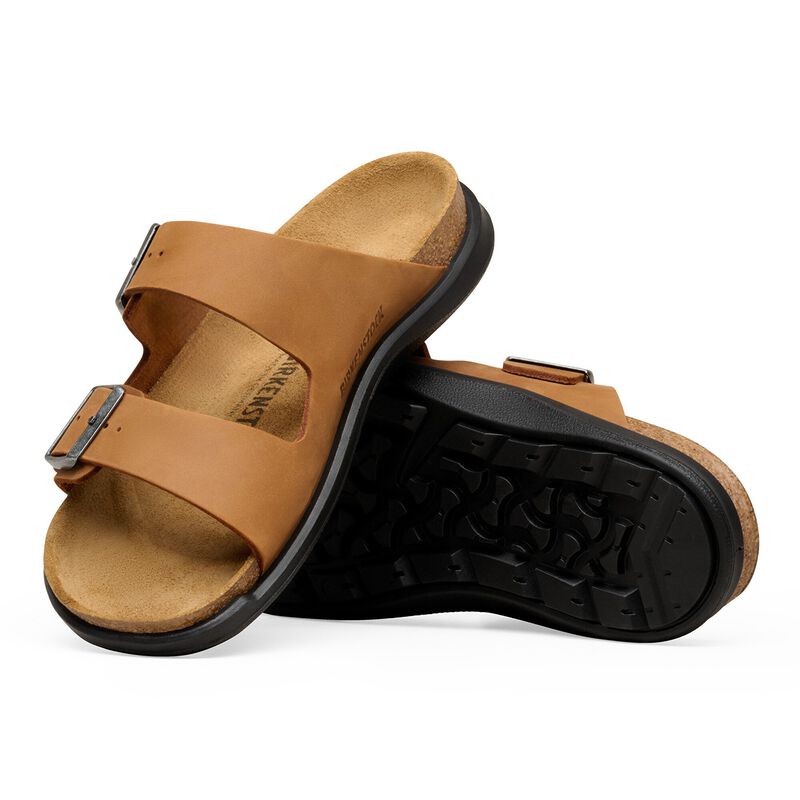
Hard floors are where the cork footbed earns its reputation. Concrete, tile, and hardwood send more shock up through the shoe than grass or carpet. The Arizona Crosstown has a cork-latex footbed and a flexible outsole, so you feel the ground but not every grain of it. In the first week, keep your hard-floor sessions short. Twenty minutes around the kitchen, then sit down. The footbed needs recovery time between wears, especially in dry climates. If you wear them for three hours on day one, the cork may compress unevenly and feel lopsided by day three.
On tile, the outsole may feel slick at first because the tread is new. Waxy leather does not affect traction, but the outsole surface does. Scuff the bottoms on pavement or concrete for a few minutes to knock off the factory smoothness. After that, the Arizona Crosstown grips well enough for errands, office hallways, and weekend walking. If you are on polished stone floors all day, consider rotating in a second pair so the cork has time to dry. Moisture is the enemy of cork. Let them air out overnight, away from direct heat.
Break-In by Color and Leather Finish
All eight colors use the same waxy leather construction: Black, Cognac, Lavender, Habana, Zinfandel, Tobacco Brown, Elemental Blue, and Basalt Gray. The difference is how they show wear. Black and Basalt Gray hide creases and scuffs longer. Cognac, Habana, and Tobacco Brown develop a patina that many people like, but it means the first week looks lived-in fast. Lavender and Elemental Blue are the outliers: they show contrast at the crease lines sooner, so if you want a clean look for a dressier setting, keep them for shorter indoor wears during the break-in. Zinfandel sits in the middle, a deep red-brown that darkens slightly with handling.
None of this changes the break-in timeline. The footbed does not care what color the strap is. What changes is your patience. If you are babying a light color, you may wear them less in the first week, which stretches the break-in over a longer period. That is fine. The cork will still take the shape of your foot. Just do not expect a lavender pair worn twice a week to feel like a cognac pair worn daily. Consistency matters more than color.
Common First-Week Mistakes
Wearing them with socks that are too thick. The Arizona Crosstown is designed to be worn barefoot or with thin socks. Thick socks change where your arch lands and can make the footbed feel too small. If you need socks for warmth, choose a thin cotton or merino blend. Second mistake: tightening the straps to stop heel slip. Heel slip in the first week often means the footbed is still flat and your heel has not settled into the cup. Give it three wears before you crank the buckle. Third mistake: walking long distances on day one. The cork footbed is not a running shoe midsole. It is a molding surface. Treat the first week as a fitting period, not a test of endurance.
When to Expect the Footbed to Feel Right
Most people feel a clear difference by day five to day seven. The arch feels supportive rather than intrusive. The heel cup holds without rubbing. The toe strap stops needing adjustment. If you are on your feet on hard floors for work, this timeline may stretch to two weeks. That is normal. The cork is doing its job slowly. If after two weeks you still feel a hard ridge under your arch or pressure on the top of your foot, check your width and strap tension again. The Arizona Crosstown is not supposed to hurt. It is supposed to feel firm, then neutral, then yours.
Once the first week is done, the shoe becomes low-maintenance. Wipe the waxy leather with a dry cloth. Keep them away from radiators and direct sun. If the cork looks dry at the edges, a thin coat of BIRKENSTOCK cork sealer helps, but most people do not need it in the first month. The Cognac Walk Edit is built for city streets, home floors, and weekend travel. The break-in is the price of a footbed that fits only you. Pay it in short walks, not long marches, and the Arizona Crosstown will feel less like a new purchase and more like a familiar pair by the end of the week.
View this BIRKENSTOCK style in the shop
People also search
how to store BIRKENSTOCK cork footbed between seasons
BIRKENSTOCK Arizona two strap too loose how to tighten
how long to break in BIRKENSTOCK cork footbed
BIRKENSTOCK Arizona vegan Birko-Flor vs leather
BIRKENSTOCK oiled leather clog care rain and commute
BIRKENSTOCK Boston fit compared to Arizona
BIRKENSTOCK sandals waterproof options EVA
BIRKENSTOCK Madrid vs Arizona for travel days
do BIRKENSTOCK sandals run small or large
how to stretch tight BIRKENSTOCK sandals at home
BIRKENSTOCK footbed packed out when to replace
BIRKENSTOCK Arizona vs Milano for ankle support
BIRKENSTOCK suede vs nubuck which scuffs less
BIRKENSTOCK cork latex footbed how long it lasts
BIRKENSTOCK sandals for nurses and long shifts
BIRKENSTOCK sandals for plantar comfort walking
BIRKENSTOCK Birko-Flor vs leather which lasts longer
BIRKENSTOCK Arizona for men first pair guide
BIRKENSTOCK kids vs adult sizing for small feet
best BIRKENSTOCK for airport travel and long flights
BIRKENSTOCK men women unisex sizing how to choose
is BIRKENSTOCK Arizona Crosstown Waxy Leather Cognac Walk Edit true to size
BIRKENSTOCK Arizona Crosstown Waxy Leather Cognac Walk Edit sizing and width fit
BIRKENSTOCK Arizona vs Super-Birki garden clog
BIRKENSTOCK sandals for sightseeing Europe cobblestones
BIRKENSTOCK soft footbed vs original footbed difference
are BIRKENSTOCK good for standing cooking at home
BIRKENSTOCK EVA sandals for beach and pool
best BIRKENSTOCK for city walking tour
BIRKENSTOCK Arizona last chance colors worth buying
Trending BIRKENSTOCK searches
BIRKENSTOCK Arizona
BIRKENSTOCK new colors
BIRKENSTOCK original footbed
BIRKENSTOCK tobacco leather
BIRKENSTOCK cork footbed
BIRKENSTOCK Birko-Flor
contoured cork-latex footbed
summer BIRKENSTOCK outfits
BIRKENSTOCK Kyoto clog
BIRKENSTOCK EVA sandals
BIRKENSTOCK Mayari
BIRKENSTOCK taupe suede
BIRKENSTOCK city walking
BIRKENSTOCK white Arizona
break-in cork footbed
BIRKENSTOCK Madrid sandal
BIRKENSTOCK black Arizona
Birkenstock clog socks
BIRKENSTOCK Gizeh
Arizona vs Boston