



Function
BIRKENSTOCK Boston Natural Leather Black City Comfort: Einlaufen in der ersten Woche, Riemenanpassung und Gehen auf hartem Boden · BIRKENSTOCK Everyday Walk
Why the Boston Clog Belongs on Your Everyday List
The BIRKENSTOCK Boston is not a shoe that asks for attention. It slides on, holds your foot, and gets out of the way. In Natural Leather Black, it reads sharp enough for a coffee run or a desk day, and in Mineral Gray it leans a little softer, pairing well with denim and worn-in chinos. This is a clog for people who walk on hard floors, whether that is a kitchen, a studio, a hospital corridor, or a city sidewalk. The cork footbed is the reason it works, and the first week is when you feel it doing its job.
What the First Week Actually Feels Like
Day one, the cork footbed is firm. You will notice the arch and the heel cup immediately, and that is normal. The footbed is not broken in yet. It has not learned your foot. For the first two or three days, wear the Boston around the house for an hour at a time. Stand at the counter, walk to the mailbox, take the trash out. That short, repeated contact is what starts the molding process. By day three or four, the cork begins to warm and yield slightly under the heel and the ball of your foot. You will feel a gentle depression forming where your weight lands. That is the footbed adapting to you, not the other way around.
By day five, the leather upper has also started to soften. Natural leather does not break in overnight. It creases where your foot flexes, and those creases are unique to your gait. The Black version shows creases a little more than Mineral Gray, but both develop a patina that makes them look less like new shoes and more like your shoes. If you wear them for a full day on day one, you will likely feel sore spots on the top of your foot or along the strap. That is not a defect. It is a sign to slow down. The first week is a negotiation, not a race.
Strap Fit: Why One Hole Makes a Difference
The Boston has a single strap across the instep, and it is adjustable. That one strap does more work than you might expect. Too loose, and your heel lifts with every step, which causes rubbing and makes the clog feel clumsy. Too tight, and you cut off circulation, especially if you are standing for long stretches. The goal is a snug hold that still lets you slide a finger under the strap. Start in the middle hole. Walk around for ten minutes. If your foot shifts forward and your toes touch the front edge, go one hole tighter. If you feel pressure on the top of your foot, go one hole looser. Leather stretches slightly with wear, so if you are between holes, choose the tighter one. It will give a little by the end of the week.
Width matters here too. BIRKENSTOCK offers the Boston in narrow and regular widths. If you have a high instep or a wide forefoot, the regular width gives you more room across the top, and the strap will not have to work as hard. If you have a narrow foot, the narrow width keeps the clog from feeling like a bucket. The Natural Leather Black and Mineral Gray both come in these width options, and getting the right one is more important than any break-in trick. A well-fitted Boston feels secure from the first step, even while the cork is still firm.
Walking on Hard Floors: What to Expect
Hard floors are where the Boston shines, but they are also where you feel the footbed most. Concrete, tile, and hardwood do not absorb impact the way grass or carpet does. The cork footbed and the EVA outsole work together to take the edge off, but they are not cloud-like. The first few days on a hard floor, your heels and knees might feel more feedback than you are used to. That is the cork doing its job: it is firm enough to support your arch, which takes strain off your knees and lower back over time. By the end of the first week, the footbed will have molded enough that the impact feels more distributed. You will notice less of a slap and more of a roll.
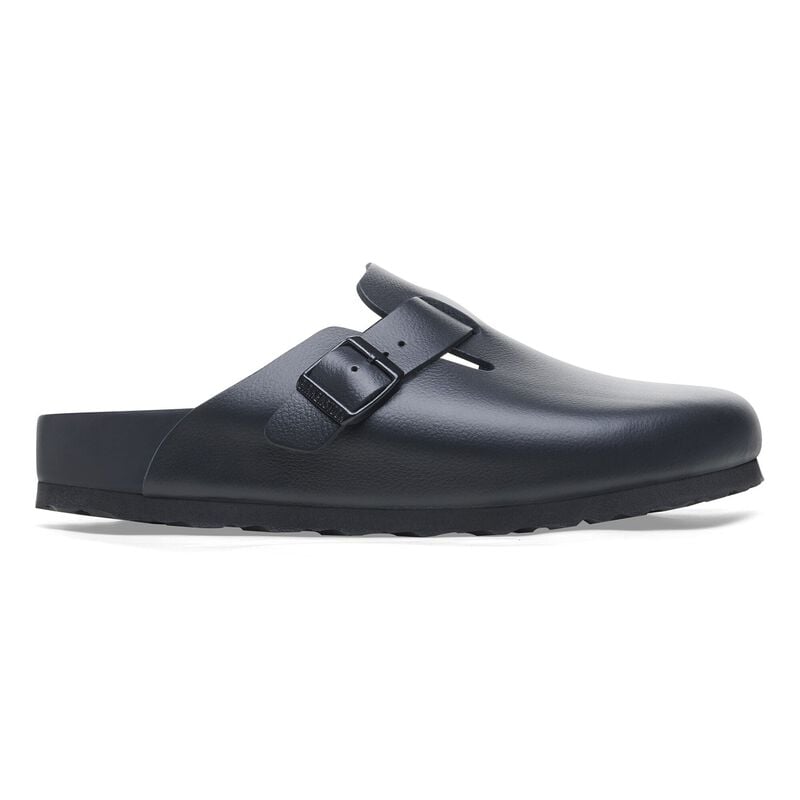
If you work on your feet all day, rotate the Boston with another pair for the first week. Wear it for four hours, then switch. This gives the cork time to cool and set, and it gives your feet time to adjust. By day seven, you can wear them for a full shift. The outsole is durable but not soft, so on slick tile or polished concrete, take shorter steps until you know how the tread grips. It is a reliable sole, but it is not a running shoe. The Boston is for walking, standing, and getting things done, not for sprinting to a train.
Black vs. Mineral Gray: Which to Choose
Black Natural Leather is the classic. It hides scuffs, works with almost any outfit, and looks intentional even when it is beat up. Mineral Gray is a quieter choice. It shows a little more contrast against dark denim and reads more casual. Both are made from the same natural leather, so the break-in is the same. If you plan to wear them in a workplace with a relaxed dress code, Black is the safer bet. If you want a clog that feels more like a weekend shoe, Mineral Gray is the one. Neither color needs special care beyond a occasional wipe with a damp cloth and a little leather conditioner every few months.
Birko-Flor, Leather, and What You Are Actually Getting
This Boston is Natural Leather, not Birko-Flor. That matters for break-in. Birko-Flor is a synthetic upper that holds its shape and needs almost no softening. Natural Leather takes a week or two to relax, but it ends up conforming to your foot in a way Birko-Flor cannot. If you have worn BIRKENSTOCK before in Birko-Flor, expect this pair to feel stiffer on day one and more custom by day ten. The cork footbed is the same across materials, so the arch and heel cup feel familiar from the first step. The difference is in the upper, and it is worth the patience.
Where the Boston Fits in Your Rotation
Use the Boston for the walk to the office, for standing at a workbench, for errands on a Saturday, and for padding around the house on a cold morning. It is not a hiking shoe and it is not a dress shoe, but it handles more than people expect. The closed toe makes it warmer than an Arizona or Madrid, so it works in fall and mild winter. The cork footbed makes it comfortable on long days. The strap keeps it secure when you are moving. If you are new to BIRKENSTOCK, the Boston is a good first pair because the fit is forgiving and the break-in is straightforward. If you already own Arizona or Madrid, the Boston feels like a natural extension, just with more coverage.
Break-In Tips That Actually Help
Wear socks for the first few days. Thin socks reduce friction while the leather and cork settle. After a week, you can switch to bare feet if you prefer. Keep the strap at the middle hole until the footbed starts to mold, then adjust. If you feel a hot spot, do not push through it. Take the shoe off, let your foot cool, and try again the next day. A hair dryer on low heat can soften a tight strap, but use it sparingly and let the leather cool before you wear it. Most of all, give it time. The first week is not the final fit. The final fit is what you get after the cork has taken your shape, and that is when the Boston stops feeling like a new shoe and starts feeling like your shoe.
By the end of the first week, you will know whether the width and strap are right. If they are, the Boston becomes the pair you reach for without thinking. If they are not, adjust the strap or consider the other width. BIRKENSTOCK sizing is consistent, so once you know your size in one style, you can trust it in another. The cork footbed is the constant, and it is the reason people keep coming back. Give it seven days. Your feet will thank you.
View this BIRKENSTOCK style in the shop
People also search
BIRKENSTOCK Boston vs Milano which for commute
BIRKENSTOCK sandals for plantar comfort walking
BIRKENSTOCK Boston break in time first week
BIRKENSTOCK Arizona mocha vs dark brown
are backless BIRKENSTOCK clogs good for walking
BIRKENSTOCK sandals lightweight hiking light trails
BIRKENSTOCK sizing guide regular vs wide width
BIRKENSTOCK Arizona taupe vs stone vs black which to buy
best BIRKENSTOCK for weekend travel packing
BIRKENSTOCK sizing EU to US conversion chart
BIRKENSTOCK Arizona mink vs tobacco oiled leather
BIRKENSTOCK arch support sandals for sightseeing
BIRKENSTOCK cork footbed squeak how to fix
BIRKENSTOCK Birko-Flor vs leather which lasts longer
best BIRKENSTOCK sandals for standing all day at work
is BIRKENSTOCK Boston Natural Leather Black City Comfort true to size
BIRKENSTOCK Arizona for men first pair guide
BIRKENSTOCK Kyoto vs Boston clog comparison
BIRKENSTOCK Arizona white vs black everyday wear
BIRKENSTOCK men women unisex sizing how to choose
best BIRKENSTOCK for city walking tour
BIRKENSTOCK Arizona two strap too loose how to tighten
BIRKENSTOCK cork latex footbed how long it lasts
how to stop heel slipping in BIRKENSTOCK Arizona
BIRKENSTOCK Arizona Big Buckle vs classic Arizona
BIRKENSTOCK footbed packed out when to replace
do BIRKENSTOCK sandals work without socks
BIRKENSTOCK Madrid vs Arizona for travel days
BIRKENSTOCK Milano ankle strap vs Arizona stability
BIRKENSTOCK Arizona vegan Birko-Flor vs leather
Trending BIRKENSTOCK searches
break-in cork footbed
BIRKENSTOCK taupe suede
BIRKENSTOCK Milano
BIRKENSTOCK cork footbed
BIRKENSTOCK shearling Boston
BIRKENSTOCK city walking
Birkenstock clog socks
BIRKENSTOCK Madrid sandal
regular vs wide BIRKENSTOCK
all day walking sandals
thong sandal Gizeh
contoured cork-latex footbed
BIRKENSTOCK airport shoes
BIRKENSTOCK mink oiled leather
BIRKENSTOCK tobacco leather
BIRKENSTOCK last chance
BIRKENSTOCK 2026 trends
BIRKENSTOCK Boston Natural Leather Black City Comfort
BIRKENSTOCK white Arizona
BIRKENSTOCK original footbed